
How verifying advanced AI agent identities and ownership can help organizations build trust and guard against malicious agents.
VerifyAI Agents, a platform designed to establish transparency regarding the identity and ownership of artificial intelligence agents. By tracking endpoints, IP addresses, and organizational owners, the service helps commercial entities streamline their Know Your Business procedures. It bridges observable network activity with verified records to improve security, compliance, and onboarding protocols. Organizations such as financial institutions, technology platforms, and risk management teams can integrate these insights through an API to make informed operational decisions. Ultimately, the system provides crucial visibility that empowers departments to securely evaluate and interact with automated software entities.
Advanced AI agents are moving beyond simple chat and search. They can connect to software, use digital tools, retrieve information, and carry out tasks across business systems. As these agents become part of everyday operations, organizations face a practical question: How can they know which agent they are interacting with—and who is responsible for it?
That question is becoming central to the safe adoption of advanced AI. A business may need to decide whether to let an agent access an application, exchange information with a service, or participate in a customer or financial workflow. Before making that decision, it needs useful information about the agent’s identity, technical footprint, and organizational owner.
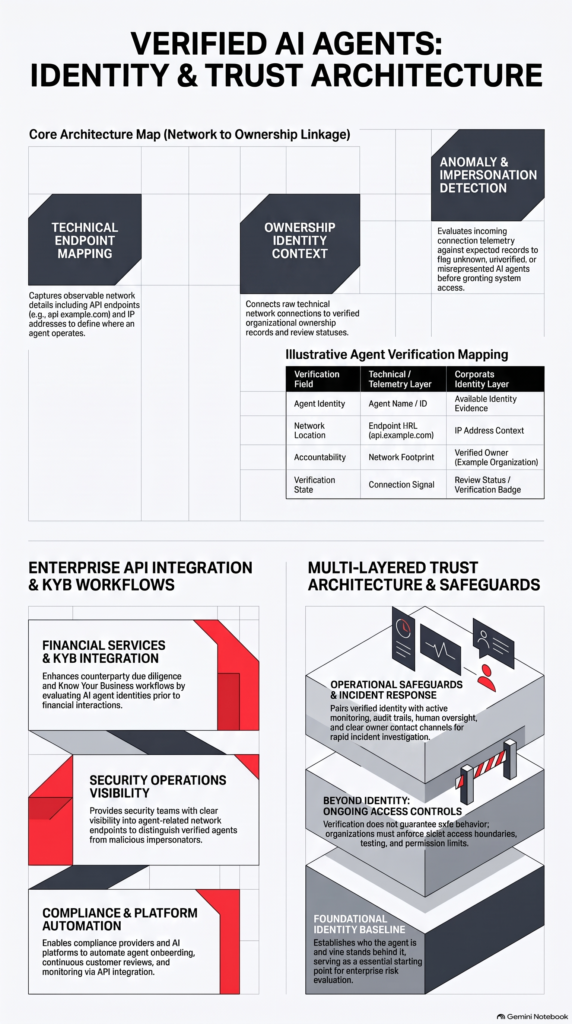
VerifyAI Agents.com is designed to provide visibility into those areas. The platform connects information about AI agents—including endpoints, IP addresses, and ownership—with identity records that organizations can consider during onboarding, compliance, and security reviews. Its website, verifyaiagents.com, describes an approach to helping businesses understand agent identity and ownership and explore how that information could fit into their Know Your Business (KYB) processes.
Why advanced AI agents need identity
Traditional software is usually deployed and managed through identifiable accounts, services, or organizations. Advanced AI agents add a more dynamic layer: they may interact with different systems, use tools, and perform tasks on behalf of a person or business. When an agent operates across organizational boundaries, the receiving organization needs to know what it is connecting to and who stands behind it.
Without clear identity information, teams may have difficulty distinguishing a recognized agent from an unknown service or determining which organization is accountable for its operation. That uncertainty can complicate vendor reviews, security checks, and business onboarding. It can also create opportunities for bad actors to impersonate legitimate agents or use unrecognized agents to seek access to systems and data.
An identity framework can help establish a clearer starting point. It can connect an agent’s name and associated organization with technical details that help teams understand how the agent is reached and where it appears in network activity.
Linking network details to ownership
An agent’s endpoint shows where a service can be contacted. IP address information can provide additional context about network activity. These details can help an organization identify the technical systems associated with an agent, but they do not, by themselves, establish who owns or operates it.
VerifyAI Agents aims to bridge that gap by bringing together endpoint and IP information with ownership records. This combination can help businesses move from seeing an unfamiliar technical connection to having more context about the agent and its associated organization.
That context may help teams spot agents that are unknown, misrepresented, or inconsistent with expected records. It can support questions such as: Is this the agent the organization expects to interact with? Is there an identifiable operator? Does the available information meet the organization’s requirements for review? If something appears unusual, teams can investigate before granting access or allowing the agent to take action.
Helping guard against bad agents
Identity and ownership information can be one useful defense against malicious or impersonating agents. By checking an agent’s available details against expected records, organizations may be better positioned to flag unfamiliar systems, investigate questionable connections, and avoid treating an unverified agent as a trusted business partner.
That distinction matters as agents gain the ability to interact with applications and perform tasks. A bad agent could attempt to misuse access, deceive users, or act in ways that create security and compliance problems. Knowing who is associated with an agent can help organizations decide whether further review is needed and who to contact when concerns arise.
Verification should not be treated as a complete defense. A verified identity does not prove that an agent’s behavior is safe or that its systems cannot be compromised. Organizations still need controls over what agents can access and do, along with monitoring and clear processes for investigating suspicious activity.
Bringing agent information into business workflows
For financial institutions, technology platforms, compliance providers, and security teams, evaluating AI agents may become part of a broader KYB process. Organizations already assess business relationships, service providers, and counterparties before granting access to systems or information. As advanced AI agents take on more tasks, those reviews may also need to account for the agents themselves.
VerifyAI Agents offers an API for organizations exploring how agent identity and ownership information might fit into their existing workflows. Teams can investigate ways to incorporate relevant data into onboarding, compliance, and security processes rather than relying only on separate manual checks.
The practical value of an API depends on the quality and availability of the information, how often records are updated, and how the organization uses the results. Each business will need to determine which checks are appropriate for its own systems, policies, and risks.
Identity is a foundation, not a guarantee
Knowing an agent’s identity and associated owner is an important step, but it does not answer every question about trust. Identity does not automatically establish that an agent is secure, accurate, fair, or appropriate for a particular task.
Organizations evaluating advanced AI agents still need to consider what an agent can access, which actions it is allowed to take, how its behavior is monitored, and what happens if it makes a mistake. Testing, access limits, human oversight, audit trails, and incident response all remain important parts of responsible deployment.
Agent verification is best understood as one layer in a broader trust architecture. It can give organizations more context about the system they are evaluating and the party associated with it. That information can then be considered alongside technical testing, governance policies, and operational safeguards to help identify risks and guard against bad agents.
The next step in AI accountability
As advanced AI agents become more capable and more deeply integrated into business operations, identity and accountability will matter as much as functionality. Organizations will need ways to understand which agents they encounter, connect them to responsible owners, and make informed decisions about how those agents are used.
VerifyAI Agents reflects this emerging need by focusing on the relationship between agent identity, network details, and organizational ownership. For businesses considering how to manage AI agents in their workflows, it offers a place to explore those capabilities and their potential role in KYB, onboarding, compliance, and security.
Learn more at verifyaiagents.com.
NOTE: VerifyAIAgents.com is looking for a few AI agents to participate in beta testing. Interested?
Contact us at +1 650 753 9000 or AI@aiworldjournal.com.
. Related articles .
 Report: Is AI in Need of Retooling? The Case for a Smarter, More Human Future
 Gemini 3 Pro Review: The Age of Generative Interfaces
 Generative AI vs. Predictive AI: The Twin Pillars of Artificial Intelligence Reshaping Our World
 AI World Annual Report 2025: The Year It Was — From Exploration to Deep Integration
 Why Your Skills Matter More Than Ever in the Age of AI (and the Rise of Vibe Coding)
 Silicon Valley AI Fever: The Race to Build the Future Before the Future Is Ready
 The Trillion-Agent Economy: How AI Will Redefine Bitcoin, Crypto, and Blockchain
 AI and Banking: The Next Frontier of Financial Automation
 Autonomy at Scale: Why the Rise of AI Agents Demands a New Security Mindset
 Why Photonics Is Becoming Critical to the Future of AI Infrastructure: The Light-Speed Evolution