
As AI-powered startups attract billions in funding, the traditional agency model faces its biggest disruption since the rise of digital marketing.
For more than two decades, the agency business has adhered to a rigid, familiar structure. At the bottom of the pyramid sit junior employees handling production and grunt work. In the expansive middle are account managers, strategists, campaign specialists, media planners, and project managers—the engine room of the industry. At the top reside senior executives responsible for client relationships, high-level vision, and growth.
This hierarchical model built some of the largest advertising, marketing, public relations, and digital agencies the world has ever seen. However, artificial intelligence is now poised to dismantle the most critical layer of that structure: the middle.
Three rapidly growing AI companies have collectively raised hundreds of millions of dollars in funding while targeting functions that have traditionally been the bread and butter of agency teams. Their rise signals a tectonic shift that could redefine how brands engage with marketing services in the AI era.
The New AI Marketing Stack
The most striking aspect of this disruption is not simply the technology these companies have built. It is who they are selling to.
Rather than positioning themselves as tools for agencies, they are increasingly selling directly to Chief Marketing Officers (CMOs) and enterprise marketing departments. The message is stark and simple: Why hire large teams when AI can execute much of the work automatically?
These three startups are attacking different layers of the traditional agency model, and investors are rewarding them with massive valuations, signaling a belief that this new stack will capture a significant portion of the estimated trillion-dollar global marketing ecosystem.
Hightouch: The AI Marketing Decision Engine
Recently valued at approximately $2.75 billion following a $150 million funding round led by Goldman Sachs, Hightouch has become one of the hottest companies in the AI-powered marketing ecosystem. The company has built AI agents capable of making marketing decisions at scale.
Instead of marketers manually determining which customer receives which message, at what time, and through which channel, Hightouch’s AI continuously analyzes customer behavior and automatically optimizes those decisions.
Global brands such as Domino’s are already using the platform to personalize customer experiences across millions of interactions. The significance goes beyond simple automation. Historically, agencies built entire departments around customer segmentation, campaign planning, audience targeting, and optimization. Hightouch is positioning AI to perform many of those functions without requiring large teams of specialists.
Three Companies Every Agency Leader Should Be Watching
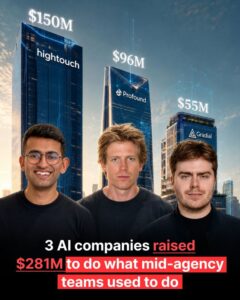
Three startups are emerging as symbols of the AI-driven transformation of marketing, and together they have raised hundreds of millions of dollars to automate functions that have traditionally required large agency teams.
📍 Hightouch (approximately $2.75 billion valuation)
Hightouch has built AI agents that determine what message to send, to whom, and when. Instead of relying on marketers to manually segment audiences and optimize campaigns, the platform continuously analyzes customer data and automatically makes those decisions in real time. Every interaction can be personalized to the individual customer. Global brands including Domino’s are already running automated campaigns on the platform, and Goldman Sachs recently led the company’s $150 million funding round.
📍 Profound (approximately $1 billion valuation)
Founded in 2024, Profound has become one of the fastest-growing companies in the emerging AI Search Economy. The platform helps brands understand and improve how they appear inside ChatGPT, Perplexity, Claude, Gemini, and other AI-powered search and answer engines. In many ways, Profound is building the next generation of SEO for a world increasingly driven by AI assistants rather than traditional search engines. The company’s rise from startup to unicorn status in roughly two years demonstrates just how quickly this market is evolving.
📍 Gradial (more than $55 million raised)
Gradial focuses on the execution layer of marketing operations. Its platform automates content updates, quality assurance, campaign deployment, website redesigns, workflow management, and other operational tasks that have traditionally required teams of marketers, designers, developers, and project managers. Its customer list already includes AWS, T-Mobile, and Prudential, highlighting growing enterprise demand for AI-powered marketing execution.
What Struck Me About All Three
What struck me about all three companies is the same thing.
They are not pitching agency owners.
They are selling directly to CMOs.
They are not selling software features.
They are selling outcomes.
And they are not targeting junior-level tasks. They are targeting the middle layer of agency operations—the strategists, campaign managers, account teams, optimization specialists, and project managers who have historically connected creative ideas to execution.
In other words, they are automating much of what sits between the brief and the final deliverable.
That is why venture capital firms are pouring billions into this category. Investors are not simply funding better marketing software. They are betting on a fundamental restructuring of how marketing work gets done.
Profound: Winning the AI Search Economy
If Hightouch is transforming customer engagement, Profound is tackling a different challenge entirely.
Founded in 2024 and already valued at more than $1 billion, Profound reflects the explosive emergence of what many analysts are calling the “AI Search Economy.”
For years, brands and their agencies focused obsessively on ranking highly on Google. Today, consumers are increasingly asking questions directly inside ChatGPT, Perplexity, Claude, and other AI assistants. Profound helps companies understand how their brands appear in AI-generated responses and provides tools to improve that visibility.
This represents a completely new category of marketing. Traditional SEO agencies spent years optimizing websites for search engines. AI visibility optimization requires understanding how large language models gather, interpret, and present information. The speed of Profound’s rise—reaching unicorn status by 2026 after a 2024 founding—demonstrates how quickly this new market is developing and how rapidly investors are moving to capture it.
Gradial: Automating Marketing Execution
While Hightouch focuses on decision-making and Profound focuses on AI visibility, Gradial addresses the execution layer.
The company has raised $55 million to automate a wide range of operational marketing tasks that traditionally require teams of project managers, designers, content specialists, and quality assurance professionals. Its platform handles content updates, campaign deployment, website changes, redesigns, quality assurance, and marketing workflow management.
Its customer roster already includes major enterprises such as AWS, T-Mobile, and Prudential. The value proposition is straightforward: eliminate the delays between strategy and execution by allowing AI systems to perform many of the tasks that previously required multiple handoffs across departments.
Why This Matters: The End of the Retainer Model?
Perhaps the most disruptive aspect of these companies is not technological, but financial. For decades, agencies have operated on retainers, hourly billing, and project fees. These AI startups are increasingly rejecting those models.
They are not pitching agency owners; they are selling directly to CMOs.
They price based on outcomes rather than retainers. They promise measurable business results instead of billable hours. Most importantly, they are targeting the middle layer of agency work—the strategists, coordinators, campaign managers, optimization specialists, and execution teams that have traditionally connected creative ideas to final delivery.
The traditional agency model monetizes people; the AI model monetizes performance. As AI systems become more capable, clients may become less interested in how many people work on an account and more interested in what outcomes are achieved. This seemingly small shift in pricing structure could have profound implications for the economics of the entire industry.
Automating the Middle
The traditional agency model has always resembled a pyramid: junior talent at the base, mid-level operators in the center, and senior leadership at the top. These AI companies are automating the middle—everything between the brief and the finished campaign.
For agency leaders, the implications are impossible to ignore. The concern is not that AI will replace creativity, brand strategy, storytelling, or executive relationships overnight. Those remain deeply human disciplines. However, many agency profit centers reside in execution, coordination, optimization, reporting, and project management—the exact functions AI systems are increasingly targeting.
This does not necessarily mean agencies will disappear. Instead, they may be forced to evolve into AI-enabled strategic partners. Future agencies could become smaller, more specialized, and more focused on creativity, business strategy, brand positioning, and human insight, while relying heavily on AI systems for execution.
The agencies most likely to thrive may not be the ones resisting AI, but the ones embracing it first. Just as digital transformed advertising in the early 2000s and social media reshaped marketing in the 2010s, AI appears poised to redefine agency economics in the second half of this decade.
For agency owners, marketing executives, and investors alike, the emergence of companies such as Hightouch, Profound, and Gradial offers a glimpse into that future. The debate over whether AI will impact agencies is largely over.
The question is no longer whether AI will change the agency business. The question is how much of the traditional agency workflow will remain human-driven over the next five years. A future is emerging where artificial intelligence is not simply a tool used by agencies, but where AI increasingly becomes the agency itself.
. Related articles .
 Exclusive Report: How AI Uses Social Media Posts: The Hidden Data Pipeline Powering Tomorrow’s Technology
 Decentralized AI: Reshaping the Future of Artificial Intelligence
 Report: Is AI in Need of Retooling? The Case for a Smarter, More Human Future
 REPORT: From Prompt to Profit: AI Agents Run Entire Businesses While You Sleep
 AI in Banking Fundamentals: How Artificial Intelligence Is Reshaping the Financial Industry
 Runway, Stability AI, and the Rise of Casting AI Agent: Hollywood’s Next Great Disruption
 The AI Adoption Gap: Why Enterprises Lag Behind Consumers in the AI Boom
 Gemini 3 Pro Review: The Age of Generative Interfaces
 The AI Productivity Supercycle: Infrastructure, Agentic Software, and the Great Market Divergence
 Why Photonics Is Becoming Critical to the Future of AI Infrastructure: The Light-Speed Evolution