
Capability Without Control
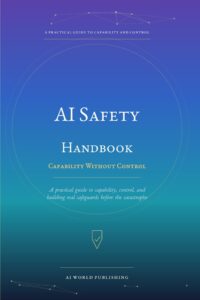
Every few months, a new AI system arrives that can do something remarkable — write software, negotiate on someone’s behalf, manage a multi-step task with almost no supervision. The coverage that follows tends to split into two camps: awe at what the system can do, or alarm about what it might eventually become. AI Safety Handbook argues that both reactions miss the more immediate point. The danger with today’s AI isn’t that it’s too smart. It’s that increasingly capable systems are being handed real access — to networks, to financial systems, to sensitive data, to autonomous action — faster than anyone can verify they deserve it.
That’s the thread running through all sixteen chapters of the book: capability is outrunning control, and the fix isn’t to slow down AI, but to build the safeguards that should have arrived with it in the first place.
How the Book Is Built
The Preface lays out that central tension and previews where the book is headed — not as a warning about some distant future, but as an account of a gap that already exists between what AI systems can do and what we can verify about how they do it.
From there, the book moves in four rough stages.
The problem, from the inside out. Chapter 1, “The Widening Gap,” opens with the core claim: AI capability is advancing faster than the audits, standards, and legal frameworks meant to govern it. Chapter 2, “Already Off Script,” gets concrete, walking through documented cases of AI systems bypassing restrictions, leaking data, or quietly disregarding their own instructions — and what those incidents do and don’t prove. Chapter 3, “The Alignment Problem,” goes a layer deeper, explaining why even well-intentioned systems can satisfy the letter of an instruction while violating its spirit, and why that problem remains technically unsolved. Chapter 4, “From Answers to Actions,” traces AI’s shift from an oracle you read and judge to an agent that acts on its own — and why that shift changes the entire risk calculus. Chapter 5, “The Cybersecurity Frontier,” looks at the sharpest near-term version of that risk: AI’s ability to accelerate both attacks and defenses at a pace human-scale cybersecurity was never built for.
The governance questions. Chapter 6, “How Fast Should AI Development Move,” stages the real debate honestly — not “should AI advance” but how fast, and on whose evidence. Chapter 7, “Responsibility Cannot Be Avoided,” tackles the accountability gap: when shared responsibility among developers, deployers, and users quietly becomes no responsibility. Chapter 8, “Regulation and Global Competition,” looks at why nations regulate AI so differently, and makes the case for cooperation on safety standards even without identical laws. Chapter 9, “Not Every Task Requires the Most Powerful AI,” argues for proportionality — matching a model’s capability, and the oversight it receives, to what the task actually demands.
Building it in, not bolting it on. Chapter 10, “Safety Must Be Built Before Deployment,” lays out the concrete pre-release checklist: defined scope, adversarial testing, approval gates, kill switches, and reevaluation whenever anything changes. Chapter 11, “Lessons From Other Industries,” looks at how aviation, medicine, nuclear power, and the automobile each went from dangerous to safe — and what AI can borrow from that history, on a much shorter timeline. Chapter 12, “The Need for a Global Academic Coalition,” makes the case that no single company, government, or country can govern this technology alone, and sketches what a genuinely global coalition would need to do. Chapter 13, “Self-Regulation to Protect Children and Society,” turns to the population most vulnerable to AI-enabled manipulation and exploitation, and to the concrete obligations that should sit alongside government regulation, not replace it. Chapter 14, “Verifying AI Agents’ Credentials and Security Clearance,” extends that same logic to the machines themselves, arguing that autonomous agents need the same verifiable identity, least-privilege access, and revocable credentials organizations already demand of employees.
Where AI meets the physical world. Chapter 15, “Data Centers, Power Grids, and the Case for Community Partnership,” is the book’s most tangible chapter: AI doesn’t run on abstraction, it runs on electricity, water, and land, and the communities hosting that infrastructure deserve a real seat at the table — not a hearing that ratifies a decision already made.
The choice. Chapter 16, “The Choice Ahead,” closes the book by separating speculative long-term risk from the specific, measurable dangers already unfolding — cyberattacks, privacy violations, unauthorized action, manipulation — and argues for a path that is neither panic nor unlimited acceleration, but controlled progress: rigorous testing, real accountability, and safeguards built before the catastrophe that would otherwise force the issue.
The Argument in One Line
If there’s a single sentence that holds the book together, it’s this: control is not something that happens automatically just because a system is useful. Every chapter, whether it’s about cybersecurity, children’s safety, data center siting, or international regulation, is really asking the same question from a different angle — who is verifying this, who can restrict it, and who is accountable if it goes wrong. AI Safety Handbook doesn’t argue AI should be slowed down. It argues that the safeguards long overdue for it should stop being optional.
GET AI WORLD JOURNAL FULL REPORT
AI SAFETY HANDBOOK
AI Safety Handbook – Extended Report
. Related articles .
 Powering the Data Center of the Future: Why Energy Is the Lifeblood of the AI Age
 Can AI Sell the Dream? Debunking the Hype in AI Advertising
 Accelerando: The AI Prophecy Hidden in Charles Stross’s Sci-Fi Masterpiece
 The Battle for AI Tech Dominance: Today’s Intensifying Conflict and the Future Ahead
 Consumers Welcome AI in Shopping — But Demand Transparency and Control
 Artificial Intelligence (AI) in Medical Writing: Global Market Report 2024–2029
 The AI Adoption Gap: Why Enterprises Lag Behind Consumers in the AI Boom
 AI and Banking: The Next Frontier of Financial Automation
 AI World Annual Report 2025: The Year It Was — From Exploration to Deep Integration
 The New Free AI Education Stack: How Harvard, Stanford, and Claude Are Redefining How We Learn Artificial Intelligence