
Understanding Artificial Intelligence Without the Hype, Fear, or Technical Jargon
I have spent decades watching technology transform the way we live, work, communicate, and build businesses. From the early days of the internet and the dot-com boom in Silicon Valley to mobile technology, cloud computing, blockchain, and now artificial intelligence, I have seen extraordinary technologies arrive surrounded by both excitement and uncertainty. But AI feels different. It is moving faster, reaching more industries, and becoming accessible to ordinary people and small businesses almost overnight. That is why I believe the first step is not chasing every new AI tool or headline. It is understanding the fundamentals: What is AI, really, and what can it actually do for us?
Strip away the marketing hype, technical jargon, futuristic predictions, and science fiction, and artificial intelligence rests on one remarkably straightforward idea:
Software can learn patterns from data and use those patterns to perform tasks, make predictions, recognize information, and generate useful outputs.
That is the foundation.
Everything else—chatbots, large language models, generative AI, autonomous agents, recommendation systems, intelligent automation, and the countless AI applications appearing every day—builds on top of that fundamental concept.
From Rules to Patterns
To understand why AI represents such an important technological shift, consider how traditional software works.
Traditional software follows rules explicitly written by programmers.
A retailer, for example, might program its system with a simple instruction:
If a customer’s order is more than $50, apply free shipping.
The computer follows that instruction exactly. It does not interpret the situation. It does not consider whether a $49.95 customer might deserve free shipping. It simply executes the rule.
AI operates differently.
Instead of requiring programmers to write instructions for every possible situation, AI systems can learn patterns from data and examples.
An AI system might learn what a satisfied customer’s email typically looks like, which language signals frustration, what purchasing behavior may indicate fraud, which sales leads appear most promising, or which customer inquiries require immediate attention.
That difference is fundamental.
Traditional software follows rules. AI recognizes patterns.
Rules are predictable, but they are rigid. AI is flexible, but its answers are often probabilistic rather than guaranteed.
That flexibility is precisely what makes modern AI so powerful.
A Practical Definition of AI
You do not need an academic definition of artificial intelligence to understand its business value.
A more practical definition is:
AI is software that uses learned patterns to perform tasks that often involve elements of human judgment—recognizing, predicting, generating, recommending, analyzing, or assisting with decisions.
That definition covers everything from spam filters and recommendation engines to today’s generative AI platforms.
A spam filter deciding whether an email belongs in your inbox uses AI.
A bank identifying an unusual transaction uses AI.
A streaming service recommending what you might want to watch next uses AI.
A generative AI system drafting an email, analyzing a spreadsheet, creating an image, summarizing a contract, or developing a marketing campaign also uses AI.
The sophistication has changed dramatically, but the basic principle remains:
Data → Patterns → Useful Output.
The Rise of Generative AI
What has made the current AI revolution particularly significant is the emergence of generative AI.
Earlier generations of AI were often designed to recognize, classify, or predict something.
Generative AI can create.
It can produce text, images, audio, video, software code, presentations, reports, advertisements, product descriptions, business plans, research summaries, and countless other forms of content.
This changes the relationship between humans and computers.
For decades, we learned how to operate software.
Now, increasingly, we can simply tell software what we want to accomplish.
Instead of learning dozens of menus and commands, you can describe the outcome you want:
Summarize this report.
Write an email to this customer.
Analyze these sales numbers.
Give me five ideas for a marketing campaign.
Turn these notes into a presentation.
The computer is becoming less like a machine we operate and more like an intelligent assistant we communicate with.
AI Is Not the Same as Automation
Another important distinction is the difference between AI and automation.
Automation follows a process.
AI can add intelligence to that process.
Imagine a customer sends a complaint to a company.
Traditional automation can receive the email, create a support ticket, assign it to a department, and send an acknowledgment.
AI can go further.
It can analyze the customer’s message, determine what the problem is, estimate how urgent it might be, summarize the issue, recommend a response, and route the customer to the appropriate employee.
Combine AI with automation and something much more powerful emerges.
The automation performs the workflow.
The AI helps understand what is happening inside that workflow.
This combination is becoming increasingly important for businesses of every size.
AI Is Powerful—but It Is Not Always Right
One of the biggest mistakes people can make is assuming that because AI sounds intelligent, everything it produces must be correct.
It isn’t.
Modern AI can produce remarkably sophisticated answers while occasionally providing incorrect, incomplete, misleading, or outdated information.
AI can even confidently generate information that is simply not true. These errors are commonly called hallucinations.
That leads to one of the most important rules for using AI:
The greater the consequence of an AI-generated answer, the greater the need for human verification.
Using AI to generate ten ideas for a social-media headline carries relatively little risk.
Allowing AI to make a major legal, medical, financial, security, hiring, or investment decision without qualified human review carries considerably more risk.
AI should enhance human judgment—not eliminate it.
The Human Still Matters
I believe one of the most useful ways to think about AI today is as a copilot rather than an autopilot.
AI can help us move faster.
It can research, summarize, analyze, organize, brainstorm, draft, translate, classify, and automate.
But humans still need to determine the destination.
A productive AI workflow often looks something like this:
Human sets the objective → AI assists with the work → Human reviews the output → AI helps refine it → Human makes the final decision.
This is often called human-in-the-loop AI.
For businesses, that balance may become increasingly important. The goal should not be removing humans from every process. The goal should be determining where machines can perform repetitive or data-intensive work while humans concentrate on judgment, relationships, creativity, strategy, and responsibility.
From AI Assistants to AI Agents
We are now entering another stage of the AI revolution: AI agents.
Most people first encountered generative AI through a chatbot. You ask a question and receive an answer.
AI agents can potentially go further.
Instead of simply responding, an agent can be given a goal and potentially determine the steps required to accomplish it, interact with tools, retrieve information, and perform authorized actions.
A chatbot might tell you how to organize your sales leads.
An AI agent might help analyze those leads, rank the strongest opportunities, prepare personalized follow-up messages, update a workflow, and present everything for your approval.
That distinction is enormous.
Chatbots answer. Agents can act.
As AI moves from generating information to taking actions, businesses will need to pay even greater attention to permissions, security, monitoring, accountability, and human oversight.
The more authority an AI system receives, the more carefully we must define what it is—and is not—allowed to do.
Your Business Data Changes Everything
General-purpose AI can know a great deal about business, marketing, technology, writing, and countless other subjects.
But it does not automatically know your business.
It does not inherently know your customers, products, inventory, policies, pricing, brand voice, internal procedures, sales history, competitive strategy, or priorities.
When AI is responsibly combined with relevant business information, its usefulness can increase dramatically.
Instead of giving generic answers, it can potentially provide answers grounded in the context of your organization.
But that opportunity comes with responsibility.
Businesses must understand how AI services handle confidential information. Customer records, passwords, proprietary information, financial data, intellectual property, and other sensitive materials should never be casually placed into an AI system without understanding the privacy and security implications.
Stop Asking, “Which AI Should I Use?”
There seems to be a new AI product announced every day.
That makes it tempting to focus on tools.
I think businesses should begin somewhere else.
Ask:
What problem am I trying to solve?
Where are employees losing time?
Which repetitive tasks consume hours every week?
Where are customers waiting too long for answers?
Which reports contain valuable information nobody has time to analyze?
Which marketing activities take too long?
Where is important knowledge scattered across documents, emails, spreadsheets, and databases?
Where could faster analysis improve a decision?
Those questions matter much more than chasing the newest AI application.
AI is a tool.
Business value is the objective.
If AI saves time, lowers costs, increases productivity, improves customer service, strengthens marketing, helps employees make better decisions, or creates new revenue opportunities, then it has value.
If it does none of those things, using AI simply because everyone is talking about it accomplishes very little.
You Don’t Need to Understand the Engine
For business owners and professionals who feel overwhelmed by AI terminology, there is one final point I consider especially important:
You do not need to understand the mathematics behind AI to use AI effectively.
Think about driving a car.
You do not need to understand every component inside the engine to determine whether the car gets you where you need to go safely and efficiently.
AI should be approached similarly.
You do not need to become a machine-learning engineer.
You need to understand what AI does well, where it struggles, what information it needs, when its answers should be verified, what information should remain private, where automation makes sense, and when human judgment must remain in control.
Those are the AI fundamentals that matter for most people and businesses.
The AI Opportunity Starts With Understanding
After decades of watching technology evolve, I have learned that transformative technologies often appear complicated at first. The internet once seemed mysterious. Websites once seemed highly technical. Cloud computing was once something primarily discussed by engineers.
Eventually, these technologies became ordinary parts of business and everyday life.
I believe AI is moving along that same path—but much faster.
The winners in this new era will not necessarily be the people who understand the most complicated AI terminology. They will be the people and organizations that understand where AI creates real value and how to apply it responsibly.
And that brings us back to where we started.
Artificial intelligence, at its foundation, is software learning patterns from data and using those patterns to perform useful tasks.
The technology behind that idea may be extraordinarily sophisticated.
But the question businesses should be asking is surprisingly simple:
What can AI help me do better today—and what could it make possible tomorrow?
That is where understanding AI really begins.
Want to Go Deeper?
This article is only an introduction to the fundamentals of artificial intelligence. For readers who want a more complete, practical roadmap, the full 120-page report, AI Fundamentals for Small Business: Understanding, Planning, and Applying Artificial Intelligence to Grow a Small Company — Without the Hype, is available as a PDF.
The full report goes beyond the basics, covering AI strategy, implementation, business applications, governance, risk, case studies, industry playbooks, and practical tools for putting AI to work in a small business.
Get the Full Report — PDF Edition
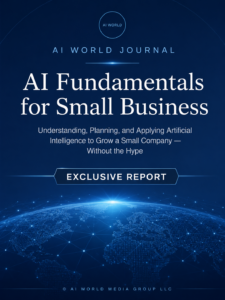
AI Fundamentals for Small Business
Strategy • Implementation • Governance
. Related articles .
 AI and Banking: The Next Frontier of Financial Automation
 Generative AI vs. Predictive AI: The Twin Pillars of Artificial Intelligence Reshaping Our World
 AI Startup Spotlight: Introducing Autonomous 101 Agentic AI™ — Ushering in a New Era of Self-Directed Intelligence
 AI World Annual Report 2025: The Year It Was — From Exploration to Deep Integration
 Where AI Is Heading: Scaling Toward 2026 and the Horizon of AGI
 The State of AI in 2026: The Year Intelligence Became Infrastructure
 AI Literacy Is Booming: The Free Course Movement Democratizing Global Skills Worldwide
 The Next Evolution of AI Agents: Self-Correction with Built-In Kill Switches
 PhdAiAgents.com: Your AI-Powered Research Lab—Smarter, Faster, and Built for PhD-Level Insight
 AI Report: The Global Powerhouses: Top 10 AI Data Centers Fueling the Future